

Islington Council is expanding its selective licensing scheme from November 2026, bringing thousands more privately rented homes under licensing requirements.
Here’s what Islington landlords and letting agents need to know about the new rules, affected areas and important deadlines.
Islington landlords need to be aware of significant changes to property licensing in Islington with a new selective licensing scheme coming into force later this year.
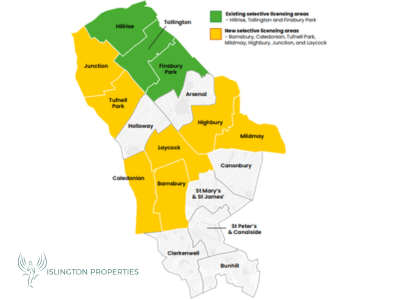
The new Islington selective licensing scheme 2026 will apply to privately rented properties across seven additional wards – Barnsbury, Caledonian, Highbury, Junction, Laycock, Mildmay and Tufnell Park.
Applications for the new licences opened on 7 September 2026, giving landlords and managing agents time to make their applications before the scheme formally comes into effect at 12am on 23 November 2026.
The designation is scheduled to remain in force until 22 November 2031 unless it is revoked earlier.
Robert Hamlyn, branch manager at Islington Properties: “The introduction of the new selective licensing areas is something landlords should be preparing for now rather than waiting until November.
“Licensing is becoming an increasingly important part of managing a rental property correctly and making sure the necessary application is in place early can help landlords avoid unnecessary problems further down the line.”
What is selective licensing?
Selective licensing is a system introduced under the Housing Act 2004 that allows local authorities to require landlords to obtain a licence for certain privately rented properties within designated areas.
Unlike mandatory or additional HMO licensing, selective licensing can apply to properties that are occupied by a single household or by one or two people sharing a property.
This means that a property does not have to be an HMO to require a licence under Islington's selective licensing scheme.
The scheme applies to private rented accommodation occupied under the new 2026 designation by:
- A single person
- Two people sharing – regardless of whether they are related
- Any number of people forming a single household or family
Carl Yankovic-Jenkins, senior property manager at Islington Properties: “One of the important points for landlords to understand is that selective licensing is not simply an HMO issue. A standard house or flat rented to a single household can also fall within the scheme if it is located in one of the designated wards.
“That means landlords who may never previously have had to think about licensing should check whether their property is affected.”
Which areas of Islington are covered by the new selective licensing scheme?
The new designation covers seven Islington wards:
- Barnsbury
- Caledonian
- Highbury
- Junction
- Laycock
- Mildmay
- Tufnell Park
The official designation was made by Islington Council on 21 August 2026.
It is important to note that these are new selective licensing areas and are separate from the existing selective licensing designation covering Finsbury Park, Tollington and Hillrise.
Islington will have selective licensing covering 10 wards in total.
What areas of Islington have not been selected by the new selective licensing scheme?
Landlords should also be aware that Holloway, Arsenal, Canonbury, St Mary’s & St James’, St Peter’s & Canalside, Clerkenwell and Bunhill are not included in the new 2026 designation.
During the council's earlier consultation both Canonbury and Clerkenwell wards had been considered as potential additions.
However, the final decision was to designate seven wards, while further detailed work was undertaken in relation to Canonbury and Clerkenwell.
Robert Hamlyn, branch manager at Islington Properties: “For landlords with properties around ward boundaries, I would strongly recommend checking the exact address rather than assuming that the property is or isn't affected.
“This is particularly important in areas where one side of a road may fall within a designated ward while another property nearby may not.”
When does Islington selective licensing start?
There are key dates landlords need to remember:
|
Date |
What happens |
|
7 September 2026 |
Applications for the new selective licences open |
|
23 November 2026 |
New selective licensing designation comes into force |
|
22 November 2031 |
Current designation is due to expire |
The council has opened applications ahead of the scheme commencing to give landlords and managing agents the opportunity to apply in advance.
This means landlords do not need to wait until 23 November to apply.
What happens if a rental property is not licensed?
Once the new designation comes into force, every private rented property covered by the scheme will be required to have a selective licence.
The council states that anyone who has control of or manages a licensable property without a licence can face prosecution under the Housing Act 2004.
The designation states that an offence can result in an unlimited fine upon summary conviction.
Alternatively, the council can issue a financial penalty which can currently be up to £40,000.
Islington Council also states more generally that landlords and managing agents who let an unlicensed property can face prosecution or a financial penalty and may also be subject to a Rent Repayment Order, potentially requiring repayment of up to 12 months' rent.
Why this matters to landlords
Licensing is not simply an administrative exercise as failing to comply can have significant financial consequences and can potentially affect the ability to manage and let a property for Islington landlords.
Carl Yankovic-Jenkins, senior property manager at Islington Properties: “The potential penalties underline why licensing should be treated as part of the normal landlord compliance process.
“For landlords using a professional letting or property management agent, it is worth having a clear conversation about who is responsible for checking licensing requirements and submitting applications. Having responsibility clearly assigned can prevent something important from being overlooked.”
Is selective licensing the same as HMO licensing?
No, this is one of the most important distinctions for Islington landlords.
Mandatory HMO licensing applies to certain larger HMOs while Islington also operates an additional licensing scheme covering other types of HMOs.
Selective licensing is different because it can apply to privately rented homes occupied by a single household or one or two people, provided the property is within a designated area.
Why has Islington introduced the new scheme?
Islington Council says property licensing is intended to help regulate the condition and management of private rented properties.
The council identifies several objectives including:
- Improving property standards and management
- Addressing anti-social behaviour
- Protecting residents from rogue landlords
- Improving safety and health standards
- Helping tackle hazards within rented accommodation
- Supporting better management of private rented homes
A changing environment for landlords
The introduction of selective licensing is part of a wider trend towards greater regulation of the private rented sector.
Landlords are already dealing with changes across areas including property safety, energy efficiency, tenancy legislation and rental property management.
Carl Yankovic-Jenkins, senior property manager at Islington Properties: “The direction of travel is very clear for landlords – compliance is becoming a much bigger part of running a successful rental property.
“Good landlords are already focused on maintaining their properties properly, responding to issues quickly and keeping the necessary paperwork up to date – licensing adds another important layer to that process.”
What should Islington landlords do now?
- Check whether your property is within a designated ward
- Establish whether your property requires a selective licence
- Apply as early as possible
- Review the property's condition
- Review your management arrangements
- Keep records
How can a letting agent help?
Licensing should form part of the wider compliance process for landlords who use a professional letting agent such as Islington Properties.
A good agent can help landlords identify whether a property is affected, advise on the application process and ensure licensing requirements are considered alongside other landlord obligations.
Robert Hamlyn, branch manager at Islington Properties: “Our role is not simply about finding a tenant. We want landlords to have confidence that the property is being managed properly throughout the tenancy.
“With changes such as selective licensing, it is particularly important that landlords have someone keeping an eye on the regulatory side of letting property as well as the day-to-day management.”
Islington selective licensing 2026 – key takeaways
The introduction of the new selective licensing scheme is an important change for landlords across parts of north and central Islington.
The key points are:
- Seven new wards are covered – Barnsbury, Caledonian, Highbury, Junction, Laycock, Mildmay and Tufnell Park
- The scheme applies to qualifying privately rented properties including homes occupied by a single household
- Applications opened on 7 September 2026
- The new scheme comes into force on 23 November 2026
- The designation is scheduled to run until 22 November 2031
- The new designation is separate from the existing selective licensing scheme covering Finsbury Park, Tollington and Hillrise
- Holloway, Arsenal, Canonbury, St Mary’s & St James’, St Peter’s & Canalside, Clerkenwell and Bunhill are not included in the new designation
- Operating a licensable property without the required licence can result in significant penalties
Robert Hamlyn, branch manager at Islington Properties: “The best approach is to be proactive. If you own a rental property in one of the affected areas, check whether the new licensing scheme applies, make your application and make sure the property is being managed to the required standard.
“Staying ahead of regulatory changes is ultimately about protecting the investment, maintaining good relationships with tenants and avoiding potentially costly compliance problems.”
Looking to let a property in Islington?
The Islington rental market continues to be an attractive option for landlords and tenants but the regulatory environment is becoming increasingly important and understanding your responsibilities as a landlord is essential.
The team at Islington Properties can help if you are considering letting a property or would like advice about the Islington rental market, property licensing or managing a rental property.
Contact Islington Properties today to discuss your property and find out how we can help with letting and managing your Islington property.
This article was based on information available in September 2026. Requirements and implementation dates may be subject to further council guidance.